Morgan le Fay
Le Morte d'ArthurMorgan le Fay is Arthur’s sister, a woman educated in necromancy who repeatedly turns her learning and access to the royal household toward dangerous ends. Her schemes range from attempted murder and theft to enchanted tests and planned ambushes; yet she is not confined to a single function, since one chapter also records her healing Alisander’s wounds. Across these episodes, her family connections place her close to the people she seeks to harm, while her magical craft makes that intimacy a source of continuing peril.
Identity and Background
Morgan is identified as one of Igraine’s daughters and Arthur’s sister. At Uther’s request, her sisters were married into powerful families, while Morgan was sent to a nunnery for schooling. There she learned so much that she became a great practitioner of necromancy. She later married King Uriens of Gore and became the mother of Sir Ewaine. Her position therefore joins royal birth, marriage, and motherhood to the learned magical capacity that defines many of her later actions.
The narrative repeatedly makes kinship a condition of access and danger. Morgan is Arthur’s sister and Uriens’s wife, but the account of her designs places those bonds alongside her willingness to act against both men. The contradiction is particularly sharp when she entrusts Arthur’s protective scabbard to her custody: family trust gives her the opportunity to undermine the protection it was meant to provide.
Plots Against Arthur and Uriens
After Arthur warns that the scabbard of Excalibur will prevent him from losing blood, he gives it to Morgan in trust. She loves Accolon more than either her husband or Arthur and wants Arthur killed. She has another scabbard made to resemble the genuine one, then gives the true scabbard to Accolon. The substitution converts a safeguard into part of a murder plan and prepares the encounter in which Arthur finds himself disadvantaged. Accolon later confesses that Morgan sent him the sword so that he would kill her brother. He says she loved him and intended, if Arthur were dead, to have Uriens killed as well, make Accolon king, and rule beside him as queen. The confession reveals that the attack is not only an attempt on Arthur’s life but part of a projected seizure of power.
Morgan’s next scheme against Uriens follows the same willingness to turn proximity into opportunity. Believing Arthur dead, she sees Uriens asleep and tells a trusted maiden to fetch her husband’s sword so that she can kill him. The maiden instead warns Sir Uwaine, who is sleeping in another chamber. Uwaine tells her to let him deal with the matter, interrupting the plot before it can be carried out. The episode extends Morgan’s threat from her brother to her husband, while showing that her household contains someone willing to intervene on Uriens’s behalf.
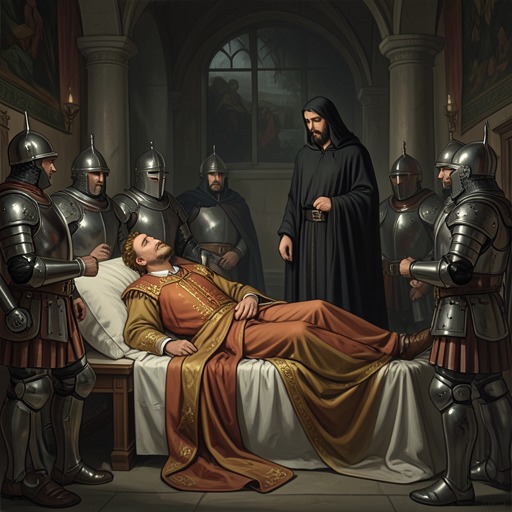
She also tries to take Excalibur itself while Arthur sleeps at an abbey of nuns. After asking Queen Guenever for permission to ride into the countryside, Morgan travels through the day and much of the night, reaches the abbey by noon the following day, and orders the nuns not to wake Arthur. She goes directly to his chamber intending to steal the sword. The episode returns to the pattern of concealed purpose beneath a request that appears ordinary: her claimed urgent business conceals an effort to deprive Arthur of his weapon.
Enchanted Objects and Their Consequences
Morgan’s hostility reaches Arthur’s court through objects that carry tests or concealed danger. She sends a golden-harnessed horn whose enchantment is supposed to reveal whether a woman is true to her husband: an unfaithful woman spills the drink, while a faithful woman can drink without spilling it. The horn is sent because of Guenever and in defiance of Sir Launcelot. When the women drink, only four pass the test. King Mark responds by swearing that Guenever and the other women should be burned, but the barons refuse to let an object made through sorcery decide their fate. They condemn the horn as a source of strife and debate, and knights vow to punish Morgan if they encounter her. The episode turns a purported instrument of judgment into a cause of public conflict, exposing the danger of treating enchantment as reliable proof.
The poisoned mantle episode makes the danger more immediate. A damsel from the Lake privately warns Arthur not to put on the mantle Morgan has sent him, nor allow any of his knights to wear it, until its bearer has first been tested. Arthur orders the messenger to wear it herself. She falls dead, and the mantle burns away. The warning exposes the hidden threat before it reaches the king or his knights, but the episode makes clear that Morgan’s gifts can be traps rather than gestures of courtly exchange.
Her magic does not serve only as a means of attack. A chapter heading records that Morgan had Alisander in her castle and healed his wounds. The brief notice supplies a counterpoint to the plots against Arthur: Morgan’s power can restore as well as endanger, even though the episodes that establish her wider narrative reputation chiefly emphasize its use in schemes and enchantments.
Ambushes and Reputation
Morgan also arranges attacks through intermediaries. A damsel seeking help for Launcelot reports that Morgan has planned to have him killed by thirty knights lying in wait. The damsel knows of the treason and recruits Sir Bors, Sir Bleoberis, Sir Ector, and Sir Driant to protect him. In a fuller account of the scheme, Morgan’s thirty ladies are to search for either Launcelot or Sir Tristram and entice whichever knight they meet toward her castle under the pretense that he can perform deeds of honor; thirty armed knights wait in a tower for their arrival. Sir Gawaine denounces the plan as treachery unbecoming a queen and a king’s sister. The arrangement combines invitation and ambush: the language of honor is used to lead a target into danger.
The response makes the scheme public. After two knights defeat the thirty men, Gawaine confronts Morgan at her castle and declares that he knows of the trap and will make its treachery known wherever he rides. Morgan and the knights answer him together, challenging his accusation and suggesting that his confidence rests on the good knight beside him. The confrontation shifts the episode from a concealed plot to an open dispute over Morgan’s reputation. Her position as Arthur’s sister and a queen does not shield the conduct from condemnation; rather, Gawaine invokes those dignities as reasons the treachery is especially shameful.
A separate chapter heading records Morgan’s grief at Accolon’s death and her theft of Arthur’s scabbard. That summary links the emotional consequence of the failed plan to another act against Arthur, reinforcing the recurring association between Accolon, the stolen protection, and her hostility toward her brother. Another heading says she saves a knight who was to be drowned before Arthur returns home, preserving a further instance in which her actions are not simply destructive.
Narrative Role
Morgan’s episodes repeatedly make family trust vulnerable to enchantment. The scabbard entrusted to a sister becomes the means by which Arthur can be deprived of protection; a wife’s access to a sleeping husband becomes an opportunity for attempted murder; and gifts sent to court conceal lethal or divisive purposes. Her designs also rely on other people—Accolon, messengers, ladies, and waiting knights—so that danger travels outward from her castle and household into the wider fellowship of Arthur’s court.
The narrative sets this repeated threat beside checks on Morgan’s power: Uwaine learns of her plan against Uriens, a damsel exposes the ambush, Gawaine challenges her publicly, and the damsel of the Lake warns Arthur about the mantle. These interruptions do not erase the danger of Morgan’s schemes; they show how information, loyalty, and vigilance can prevent her secret designs from succeeding. The account of Alisander’s healing and the rescue of a drowning knight complicate the pattern, but the central significance of Morgan’s character remains her capacity to make kinship, hospitality, and enchanted objects serve purposes that imperil the people around her.